This article is based on a real project. It showcases an example of routing with multiple source addresses. It explains how to access the values of each source address inside the routing function.
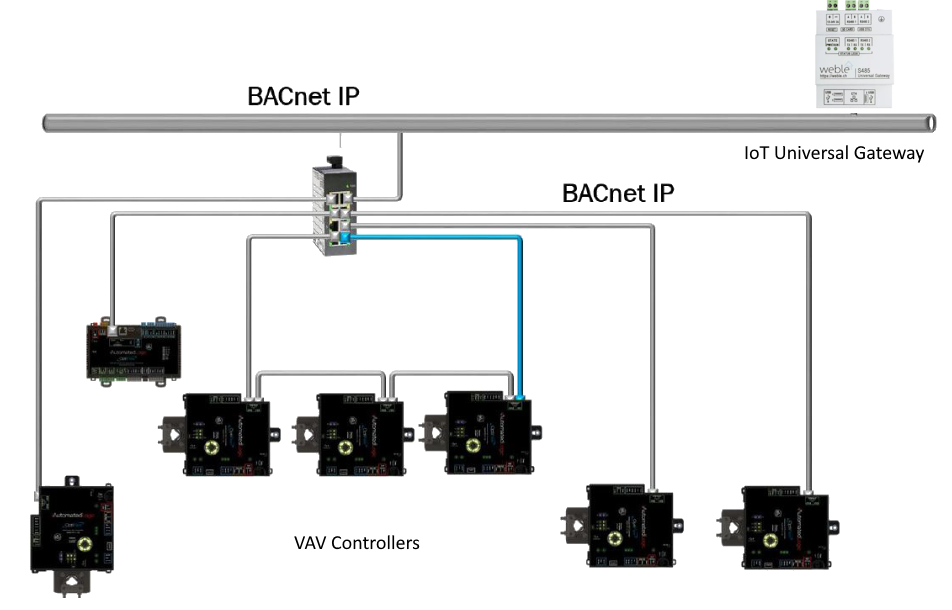
Here each VAV (Variable Air Volume) controllers has 4 inputs of type bacnet analogValue
- Temperature setpoint (analogValue:1)
- Actual temperature (analogValue:2)
- Maximum airflow (analogValue:3)
- Actual airflow (analogValue:4)
And a single output of type bacnet binaryValue (binaryValue:1).
Here the final goal is to define a routing function which takes as source values the 4 inputs, and as destination the binary value. The function must return 1 if one of the two following conditions is fulfilled:
- condition 1) the airflow is greater than 85% of the maximum airflow: Actual airflow > 0.85 * Maximum airflow.
- condition 2) the actual temperature is lower than the temperature setpoint : Actual temperature < Temperature setpoint
There is two main methods to design routes with multiple sources
- The first method is using a simple array as presented in section 1.
- The second method is to use a dictionary with named entries for each input as shown in section 2.
The same routing function is used for all VAV controllers, and each VAV controllers has its own route. Section 3 shows how to save the routing function and re-use it across different routes without having to copy/paste multiples times the same function.
¶ 1. Using an array for sources
In this section the inputs are passed as an array in Source address. So the inputs will be distinguished based on their position in the array.
¶ 1.1 Source address
["%bac:<deviceip_ip>/analogValue:1",
 "%bac:<deviceip_ip>/analogValue:2",
 "%bac:<deviceip_ip>/analogValue:3",
 "%bac:<deviceip_ip>/analogValue:4"]
¶ 1.2 Source value function
The fourth parameter of the routing function, here named infos, has a property sources which permits to access the sources by index or key.
function VAVregulation(v,src,dst,infos){
  // retrives the source addresses values
  // here the order of source addresses is important.
  var temperatureSetpoint = infos.sources[0] && infos.sources[0].value
  var actualTemperature = infos.sources[1] && infos.sources[1].value
  var maximumAirflow = infos.sources[2] && infos.sources[2].value
  var actualAirflow = infos.sources[3]  && infos.sources[3].value

  // checks that all values are defined to continue.
  if(typeof temperatureSetpoint != "number") return
  if(typeof actualTemperature != "number") return
  if(typeof maximumAirflow != "number") return
  if(typeof actualAirflow != "number") return

  // computes the 2 conditions
    var condition1 = actualAirflow > 0.85 * maximumAirflow
  var condition2 = actualTemperature < temperatureSetpoint

  // writes 1 or 0 to the destination binaryValue.
  return (condition1 || condition2) ? 1 : 0
}
¶ 1.3 route summary
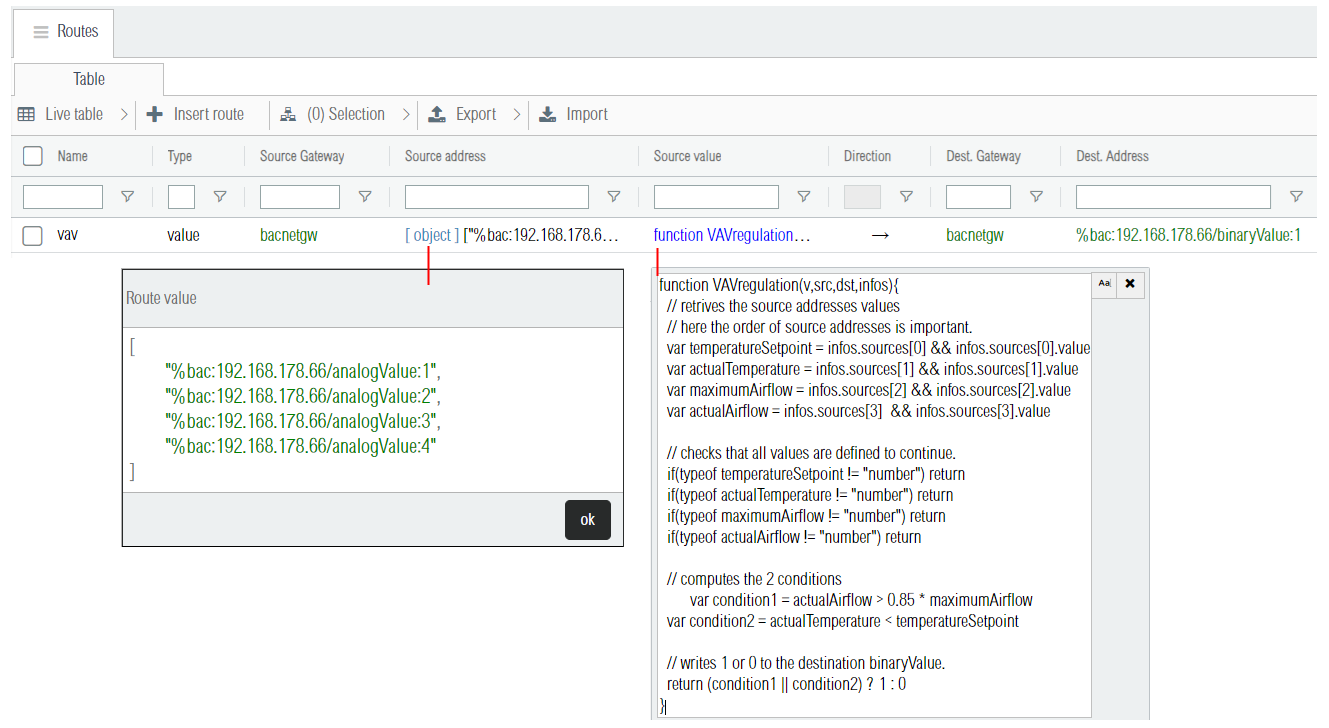
Below a summary example with bacnet device ip 192.168.178.66.
¶ 2. Using a dictionary for sources
Using a dictionary with your textual keys (here "ts" for the temperature setpoint, "at" for the actual temperature, "ma" for the maximum airflow, and "aa" for the actual airflow) is a cleaner solution compared to simple arrays. It permits to define custom keys / labels for better comprehension and it avoids potential ordering mistakes possible with simple arrays.
¶ 2.1 Source address
The source address can also be an object with source name
{
    "ts" : "%bac:<device_ip>/analogValue:1",
  "at" : "%bac:<device_ip>/analogValue:2",
  "ma" : "%bac:<device_ip>/analogValue:3",
  "aa" : "%bac:<device_ip>/analogValue:4"
}
¶ 2.2 Source value function
The routing function must be adapted to use the source addresses dictionary keys instead of the position / index in the array.
function VAVregulation(v,src,dst,infos){
  // retrieves the addresses by their keyname and their value if the address exists
  var temperatureSetpoint = infos.sources["ts"] && infos.sources["ts"].value
  var actualTemperature = infos.sources["at"] && infos.sources["at"].value
  var maximumAirflow = infos.sources["ma"] && infos.sources["ma"].value
  var actualAirflow = infos.sources["aa"] infos.sources["aa"] aa.value

  // checks that all values are defined to continue.
  if(typeof temperatureSetpoint != "number") return
  if(typeof actualTemperature != "number") return
  if(typeof maximumAirflow != "number") return
  if(typeof actualAirflow != "number") return

  // computes the 2 conditions
    var condition1 = actualAirflow > 0.85 * maximumAirflow
  var condition2 = actualTemperature < temperatureSetpoint

  // writes 1 or 0 to the destination binaryValue.
  return (condition1 || condition2) ? 1 : 0
}
¶ 3. Routing function re-use
In order to avoid copy/pasting the routing function in all routes, we can either store the routing function in a routing function block (section 3.1) or in an address of the internal gateway (section 3.2)
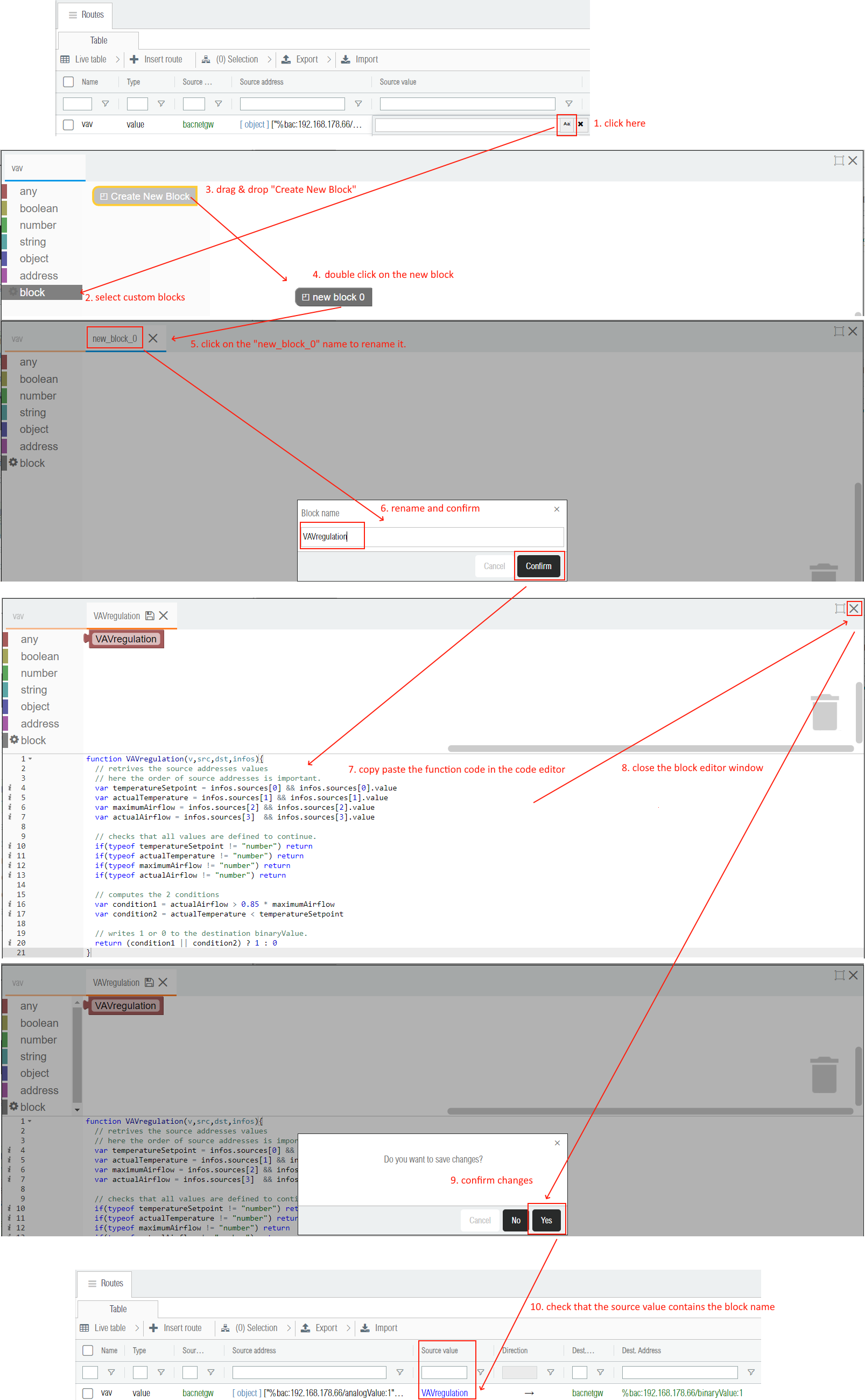
¶ 3.1 Custom block function
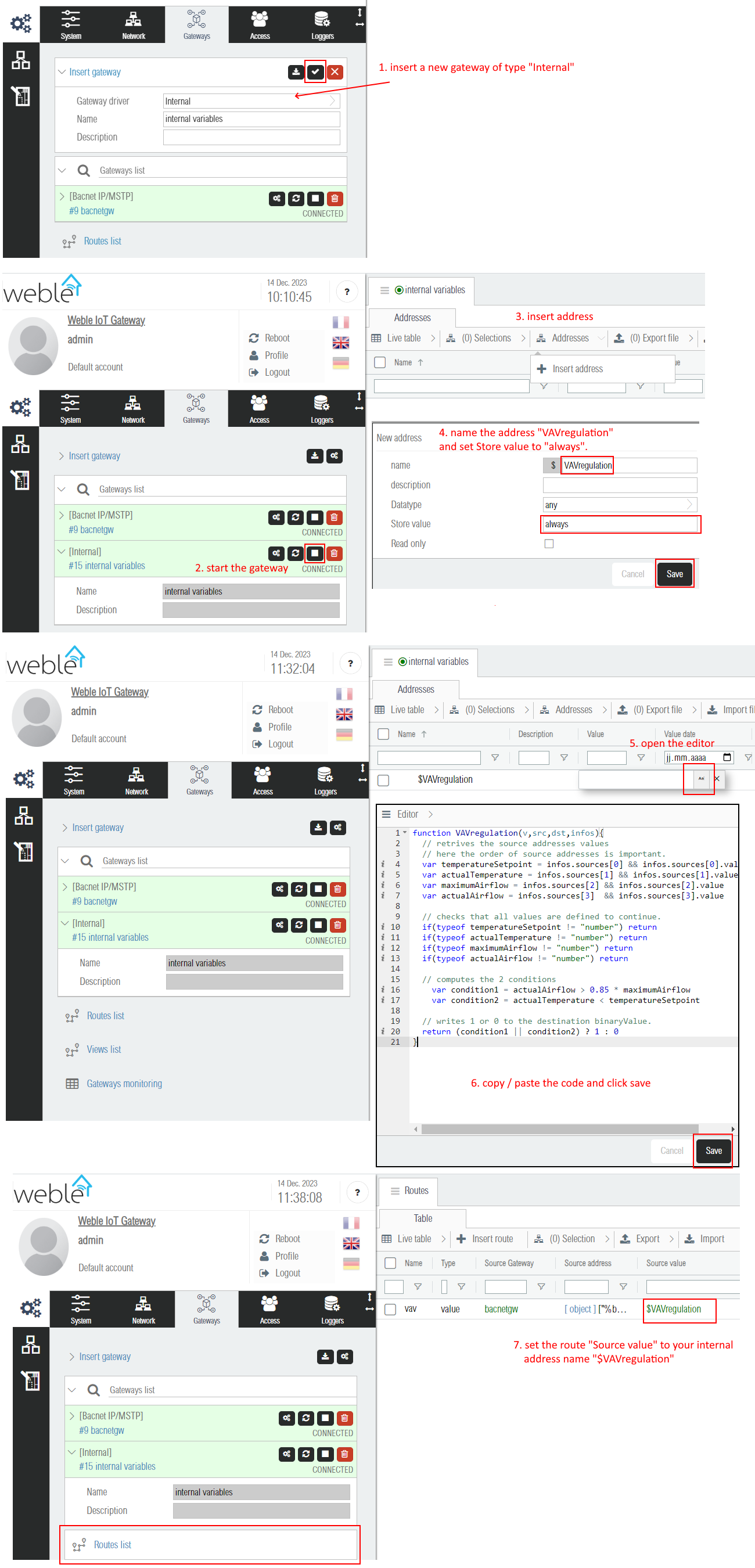
¶ 3.2 Internal address function