Some energy meters do not provide instantaneous consumptions / productions such as kW for electricity or m3/h for water, but only a global value indicating the total electricity (kWh) or water (m3) consumed since the meter is installed. Chapter 1 explains how to convert a counter value to instantaneous (derivative computation).
Sometimes on the contrary the available data is only instantenous power such as kW or m3/h. In this case the gateway can do the counting (integral computation) and store it in a file as explained in Chapter 2.
¶ 1. Counter to instantaneous
The easiest method is to use the native block covOverTime and a more advanced and customizable approach is to code the routing.
¶ 1.1 covOverTime block
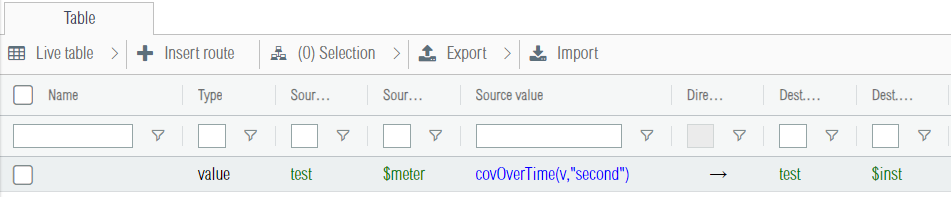
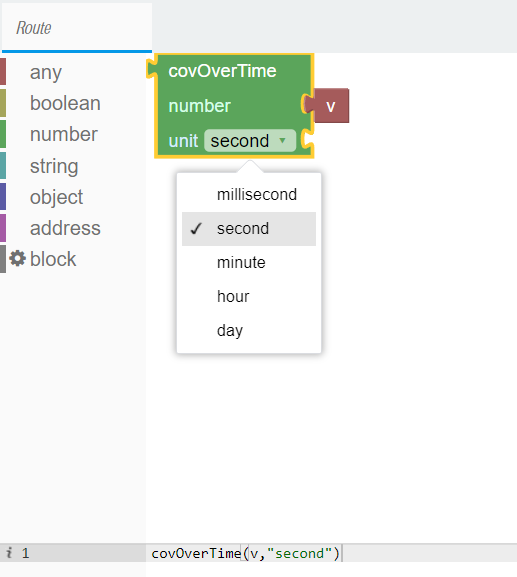
With this approach, by editing the route Source value field, the covOverTime (Change Of Value over time) block can be added. The time unit can be selected (millisecond, second, minute, hour, day). For example to convert m3 to m3/h or kWh to kW the unit hour needs to be selected.
¶ 1.2 custom function code
It is possible to achieve the same result by designing a custom Javascript function. in the routing function, the options.functionContext is used to store the previous value and its timestamp in order to do the computation. The resulting function (below m3_to_m3_per_hour) can be stored in an internal gateway and re-used on multiple routes.
Note that we don't need to sample the meter value at precise predefined time intervals, because the difference of time is computed inside the function.
function m3_to_m3_per_hour(v,src,dst,options){
    var last = options.functionContext.last
    var lastDate = options.functionContext.lastDate

    // Stores the current value and its timestamp for the future execution
    options.functionContext.last = v
    options.functionContext.lastDate = Date.now()

    // If it is the first value received, we cannot do the difference.
    // In this case, the routing function returns nothing and stops here.
    if(last === undefined) return

    // Date.now returns the time in milliseconds, and here the "dt" variable
    // represents the time elapsed between the 2 last values in milliseconds
    // and there is 3600000 milliseconds in one hour.
    var dt = Date.now() - lastDate

    // the difference of value (derivative) divided by the time difference
    // returns the rate of change over time.
    return (v-last)*( 3600000 / dt)
}
¶ 2. Instantenous to Counter
The following routing function can be used to integrate the instantenous value over time.
function m3_per_hour_to_m3(v,source,destination,options){
    var last = options.functionContext.last
    var lastDate = options.functionContext.lastDate

    options.functionContext.last = v
    options.functionContext.lastDate = Date.now()

      // If it is the first value received, we cannot do the difference.
    // In this case, the routing function returns nothing and stops here.
    if(last === undefined) return

    var dtHours =  (Date.now() - lastDate) / 3600000

    return (destination.value || 0 ) + (( last + v ) / 2)*dtHours
}
Example of a route

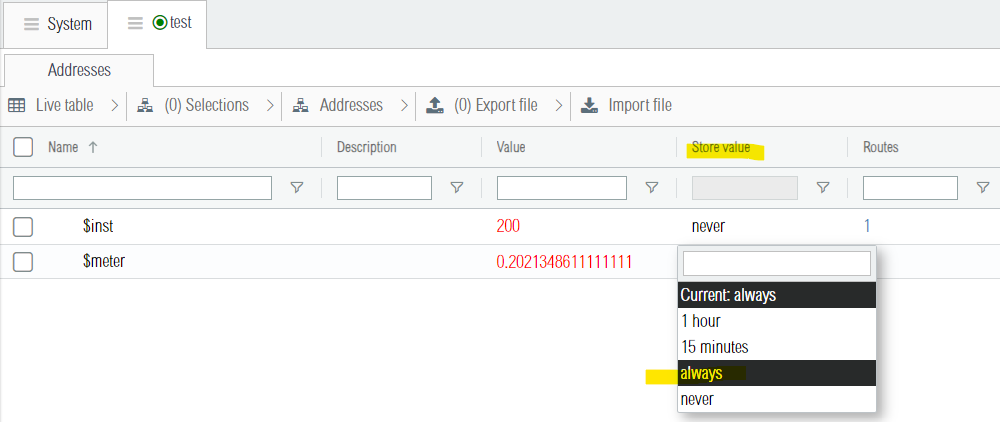
It is important to store the value of the counter, in case of a reboot.