The Weble IoT Universal Gateway runs on a range of purpose-built industrial hardware. All models share the same software stack — the same drivers, the same routing engine, the same APIs — but differ in physical I/O, connectivity, processing power, and form factor.
All models feature DIN-rail mounting, an Armbian-based Linux OS, and a reset button that restores the default IP (192.168.1.99) and admin credentials.
¶ Models overview
| Model | CPU | RAM | Ethernet | RS485 | Special | Best for |
|---|---|---|---|---|---|---|
| E413-LTE | 4× Cortex-A72 1.5 GHz | 4 GB | 2× (1 Gbps + 100 Mbps) | 2× | LTE Cat 1 modem | Remote sites with cellular uplink |
| G110 | 4× Cortex-A7 1.2 GHz | 1 GB | 2× (1 Gbps + 100 Mbps) | 2× | Dual Ethernet | Multi-network setups, protocol bridging |
| S485 | 4× Cortex-A7 1.2 GHz | 1 GB | 1× (100 Mbps) | 2× | Wi-Fi AP/client | Standard field-bus gateway |
| S485 KNX | 4× Cortex-A7 1.2 GHz | 1 GB | 1× (100 Mbps) | 1× | KNX twisted pair port | KNX building automation |
| S103 | 4× 1.2 GHz | 1 GB | 1× (100 Mbps) | 1× | Digital/analog I/O, 1-Wire | Direct I/O control + protocol gateway |
¶ E413-LTE
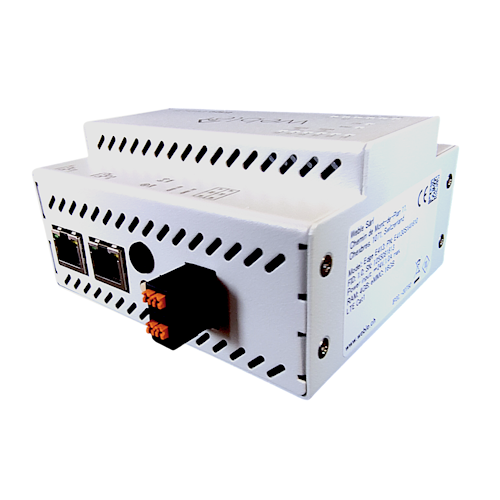
The flagship model with the most processing power and a built-in 4G/LTE Cat 1 modem with SIM slot. Ideal for remote or mobile installations where a wired internet connection is unavailable.
| Spec | Value |
|---|---|
| CPU | 4× Arm Cortex-A72, max 1.5 GHz |
| RAM | 4 GB |
| Storage | 16 GB eMMC |
| Ethernet | 2× (1 Gbps + 1 Gbps) |
| RS485 | 2× (Modbus / BACnet) |
| USB | 3× USB + 1× USB-OTG |
| Cellular | LTE Cat 1 modem with SIM slot |
| Power | 12–24 V DC |
| Housing | Compact aluminum chassis, IP20, DIN-rail |
| Weight | 0.6 kg |
| RTC | Yes, battery-backed |
| OS | Armbian |
The USB-OTG port emulates Ethernet at IP 22.22.22.22 for direct laptop-to-gateway connection during commissioning.
¶ G110
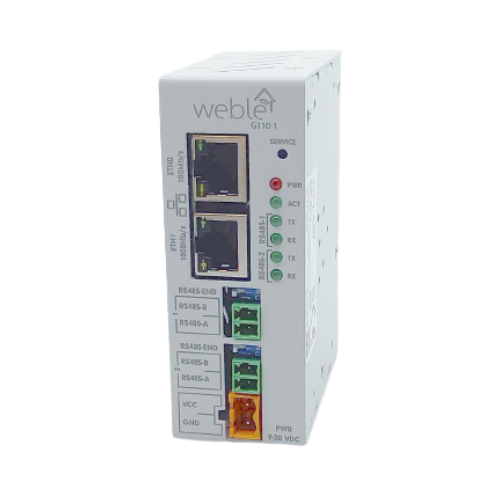
A dual-Ethernet model with two RS485 ports. The two Ethernet interfaces make it suitable for multi-network deployments — one port on the building LAN, the other on the field-bus network or a management VLAN.
| Spec | Value |
|---|---|
| CPU | 4× Cortex-A7, 1.2 GHz |
| RAM | 1 GB |
| Storage | 16 GB eMMC + microSD slot |
| Ethernet | 2× (1 Gbps + 100 Mbps) |
| RS485 | 2× (Modbus / BACnet) |
| USB | 3× USB + 1× USB-OTG |
| Power | 12–24 V DC |
| Housing | Compact aluminum chassis, IP20, DIN-rail |
| Weight | 0.6 kg |
| RTC | Yes, battery-backed |
| OS | Armbian |
¶ S485
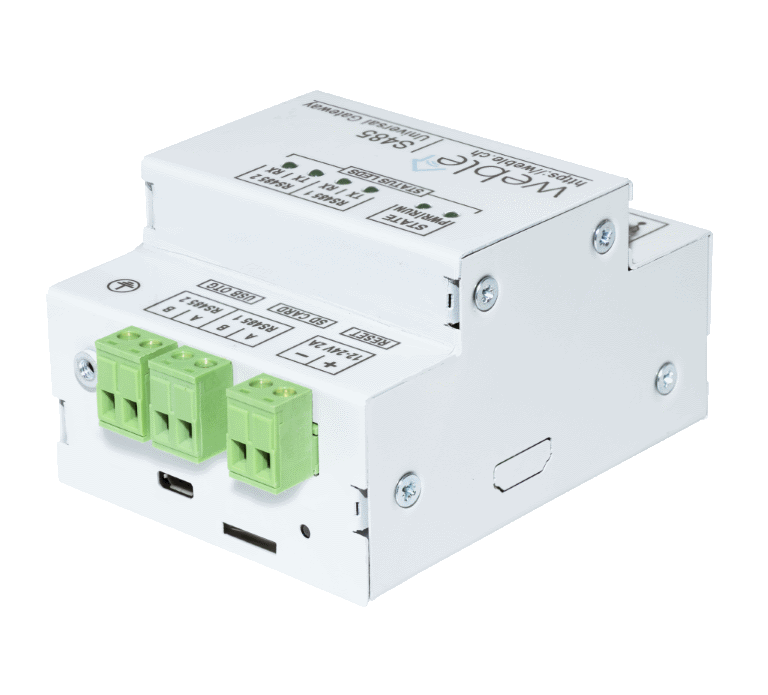
The standard field-bus gateway with two RS485 ports and Wi-Fi capability (access point or client mode). A versatile and cost-effective choice for most building automation projects.
| Spec | Value |
|---|---|
| CPU | 4× Cortex-A7, 1.2 GHz |
| RAM | 1 GB |
| Storage | microSD card (included, Armbian pre-installed) |
| Ethernet | 1× (100 Mbps) |
| RS485 | 2× (Modbus / BACnet) |
| USB | 3× USB + 1× USB-OTG |
| Wi-Fi | Access point / client |
| Power | 12–24 V DC |
| Housing | Steel case, DIN-rail (35 mm) |
| Weight | 0.6 kg |
| RTC | Yes, battery-backed |
| OS | Armbian |
¶ S485 KNX
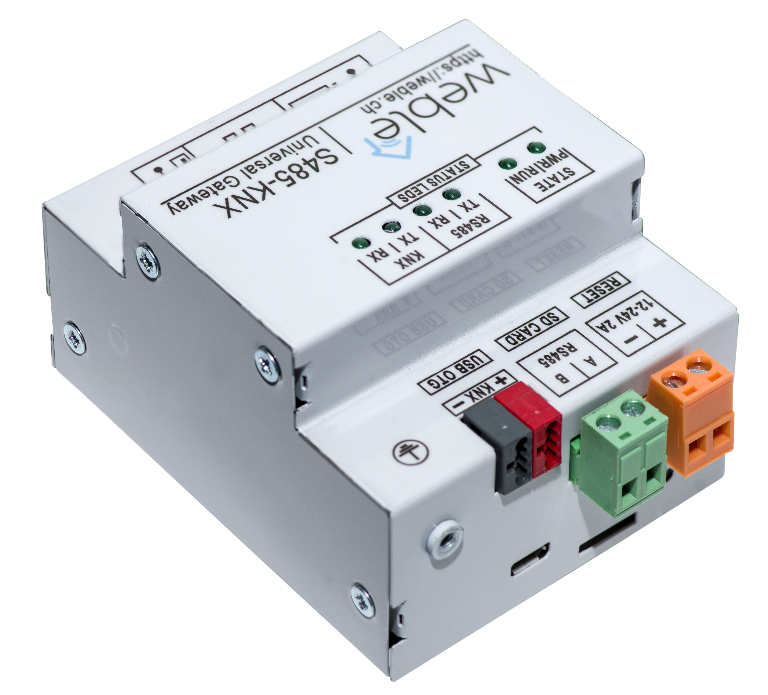
Same platform as the S485 but with one RS485 replaced by a native KNX twisted pair port. Connects directly to the KNX bus without an external KNX/IP router — the simplest setup for KNX integration.
| Spec | Value |
|---|---|
| CPU | 4× Cortex-A7, 1.2 GHz |
| RAM | 1 GB |
| Storage | microSD card (included, Armbian pre-installed) |
| Ethernet | 1× (100 Mbps) |
| RS485 | 1× (Modbus / BACnet) |
| KNX | 1× twisted pair (direct bus connection) |
| USB | 3× USB + 1× USB-OTG |
| Wi-Fi | Access point / client |
| Power | 12–24 V DC |
| Housing | Steel case, DIN-rail (35 mm) |
| Weight | 0.6 kg |
| RTC | Yes, battery-backed |
| OS | Armbian |
See the KNX driver documentation for connection modes and ETS remote access.
¶ S103
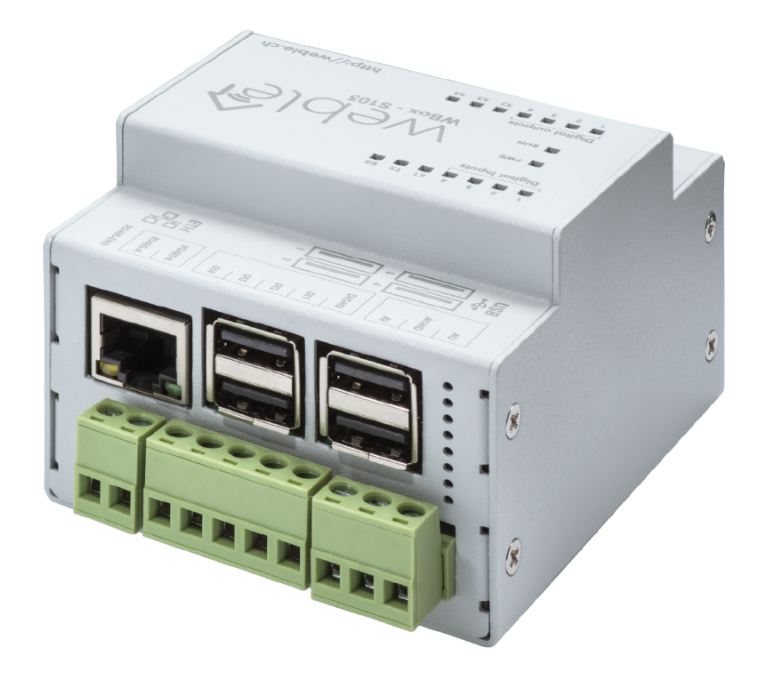
An I/O controller with built-in digital inputs/outputs, analog I/O, and a 1-Wire bus — ideal when the gateway needs to interact directly with sensors and actuators without an external PLC. Also includes an RS485 port for field-bus connectivity.
| Spec | Value |
|---|---|
| CPU | 4× 1.2 GHz |
| RAM | 1 GB |
| Storage | microSD card (included) |
| Ethernet | 1× (100 Mbps) |
| RS485 | 1× (Modbus / BACnet) |
| Digital inputs | 4× (5–24 V DC) |
| Digital outputs | 4× transistor (max 750 mA @ 50 V DC) |
| Analog input | 1× (0–10 V / 4–20 mA) |
| Analog output | 1× (0–10 V) |
| 1-Wire | 1× bus with galvanic isolation |
| USB | 4× |
| Wi-Fi | Access point / client |
| Power | 24 V DC |
| Housing | Anodized aluminum, DIN-rail (35 mm) |
| Weight | 0.6 kg |
| RTC | Yes, battery-backed (7-day retention) |
The I/O is accessed through the IO driver. The 1-Wire bus supports temperature sensors (DS18B20 and compatible).
¶ Common features
Regardless of the model, every Weble IoT Universal Gateway provides:
- The full set of communication drivers — Modbus, BACnet, KNX, OPC UA, MQTT, HTTP, M-Bus, and 30+ more. No driver is model-specific.
- The routing engine, logic module, and views.
- The Peers API and REST API.
- Local logging via the loggers module.
- Tinc VPN client for the Weble Cloud mesh network.
- PM2-based process supervision with automatic restarts and crash logs.
- Firmware and supervision upgrades over HTTP.
¶ Choosing a model
| Need | Recommended model |
|---|---|
| Cellular / remote site without wired internet | E413-LTE |
| Dual-network (building LAN + field-bus network) | G110 |
| Standard Modbus / BACnet / MQTT gateway | S485 |
| Direct KNX bus connection without IP router | S485 KNX |
| Direct sensor/actuator I/O (no external PLC) | S103 |
| Maximum processing power or large-scale installations | E413-LTE (4 GB RAM, Cortex-A72) |
All models are available at weble.ch. Contact Weble for pricing and availability.
¶ Identifying the model at runtime
From the gateway web UI: Administration → System → About.
From the API:
peer('supervision').require('system', function(err, system){
    system.getInformations(function(err, info){
        console.log('hardware:', info.baseDevice)
    })
})