The Weble IoT Universal Gateway runs on a range of purpose-built industrial hardware. All models share the same software stack — the same drivers, the same routing engine, the same APIs — but differ in physical I/O, connectivity, processing power, and form factor.
All models feature DIN-rail mounting, a Linux OS (Armbian or Debian, depending on the model), and a reset button that restores the default IP (192.168.1.99) and the default admin password. On devices prepared from version 9.1, this is the password printed on the device label: see First start. How long to hold the button on each model, and what it erases: see Reset and recovery.
¶ Models overview
| Model | CPU | RAM | Ethernet | RS485 | Special | Best for |
|---|---|---|---|---|---|---|
| E413-LTE | 4× Cortex-A72 1.5 GHz | 4 GB | 2× 1 Gbps | 2× | LTE Cat 1 modem | Remote sites with cellular uplink |
| E413-MBUS-LTE | 4× Cortex-A72 1.5 GHz | 1 GB | 2× (1 Gbps + 100 Mbps) | 2× | LTE Cat 1 modem, M-Bus master | Remote metering with cellular uplink |
| G110 | 4× Cortex-A7 0.8 GHz | 1 GB | 2× (1 Gbps + 100 Mbps) | 2× | Dual Ethernet | Multi-network setups, protocol bridging |
| S485 | 4× Cortex-A7 1.2 GHz | 1 GB | 1× (100 Mbps) | 2× | — | Standard field-bus gateway |
| S485 KNX | 4× Cortex-A7 1.2 GHz | 1 GB | 1× (100 Mbps) | 1× | KNX twisted pair port | KNX building automation |
| S103 | 4× 1.2 GHz | 1 GB | 1× (100 Mbps) | 1× | Digital/analog I/O, 1-Wire | Direct I/O control + protocol gateway |
¶ Built-in serial ports
In the Serial Port field of a serial gateway (Modbus RTU, BACnet MS/TP, KNX TP, M-Bus…), each built-in port of the device is listed with its system path followed by its name, for example /dev/ttyS1 Weble RS485 1. The path is the value saved in the gateway.
| Model | Name in the list | Path |
|---|---|---|
| G110 | RS485 1, RS485 2 |
/dev/ttyS1, /dev/ttyS2 |
| S103 | RS 485 |
/dev/extcomm/1/0 |
On the other models, the built-in ports are named the same way: RS485 1 and RS485 2 for the RS485 ports, MBUS 1 for the M-Bus master of the E413-MBUS-LTE, and KNX TP UART for the KNX twisted pair port of the S485 KNX. The paths of every model are listed in Serial ports and USB adapters.
¶ Serial ports and USB devices
When a gateway needs a serial port, the Serial Port list shows the built-in ports of the device (see Built-in serial ports) and the USB adapters plugged in (RS485, KNX, EnOcean, Z-Wave…), with their product name and unique ID. On the S103, the USB sockets are shown as USB 1 to USB 4.
For a USB adapter, click its unique ID rather than its port: the unique ID is built from the manufacturer, the product and the serial number, so it stays the same after a reboot or when the adapter moves to another USB socket (two identical adapters without a serial number are numbered in socket order). If an adapter is missing from the list, the device does not detect it: check the cable and the adapter. Radio sticks (Zigbee, EnOcean, LoRaWAN), serial settings and error messages: see Serial ports and USB adapters.
USB storage devices are mounted automatically; they can hold the remanent values (see System configuration).
¶ E413-LTE
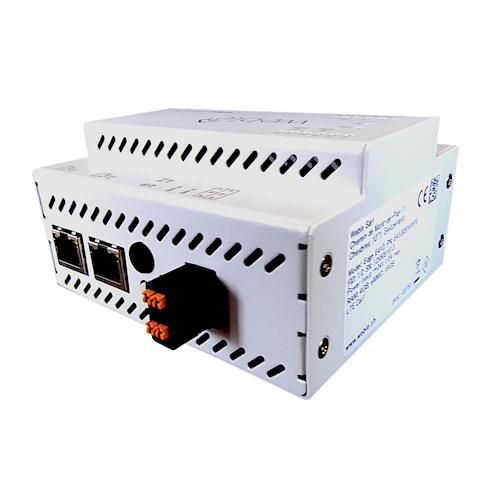
The flagship model with the most processing power and a built-in 4G/LTE Cat 1 modem with SIM slot. Ideal for remote or mobile installations where a wired internet connection is unavailable. Modem commissioning: see LTE modem and SIM card.
| Spec | Value |
|---|---|
| CPU | 4× Arm Cortex-A72, max 1.5 GHz |
| RAM | 4 GB |
| Storage | 16 GB eMMC |
| Ethernet | 2× 1 Gbps |
| RS485 | 2× (Modbus / BACnet) |
| USB | 3× USB |
| Cellular | LTE Cat 1 modem with SIM slot |
| Power | 12–24 V DC |
| Housing | Compact aluminum chassis, IP20, DIN-rail |
| Weight | 0.35 kg |
| RTC | Yes, battery-backed |
| OS | Debian |
¶ E413-MBUS-LTE
The E413-LTE platform with a built-in M-Bus master for up to 60 meters, for remote metering over a cellular uplink. Modem commissioning: see LTE modem and SIM card; M-Bus: see M-Bus.
| Spec | Value |
|---|---|
| CPU | 4× Arm Cortex-A72, max 1.5 GHz |
| RAM | 1 GB |
| Storage | 16 GB eMMC |
| Ethernet | 2× (1 Gbps + 100 Mbps) |
| RS485 | 2× (Modbus / BACnet) |
| M-Bus | 1× master, up to 60 meters |
| USB | 3× USB |
| Cellular | LTE Cat 1 modem with SIM slot |
| Power | 12–24 V DC |
| Housing | Aluminum chassis, IP20, DIN-rail |
| Weight | 0.35 kg |
| OS | Debian |
¶ G110
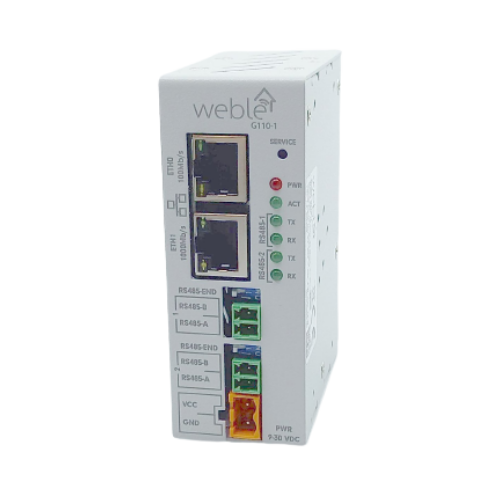
A dual-Ethernet model with two RS485 ports. The two Ethernet interfaces make it suitable for multi-network deployments — one port on the building LAN, the other on the field-bus network or a management VLAN.
| Spec | Value |
|---|---|
| CPU | 4× Cortex-A7, 0.8 GHz |
| RAM | 1 GB |
| Storage | 16 GB eMMC + microSD slot |
| Ethernet | 2× (1 Gbps + 100 Mbps) |
| RS485 | 2× (Modbus / BACnet) |
| USB | 1× USB |
| Power | 12–24 V DC |
| Housing | Compact aluminum chassis, IP20, DIN-rail |
| Weight | 0.25 kg |
| RTC | Yes, battery-backed |
| OS | Armbian |
¶ S485
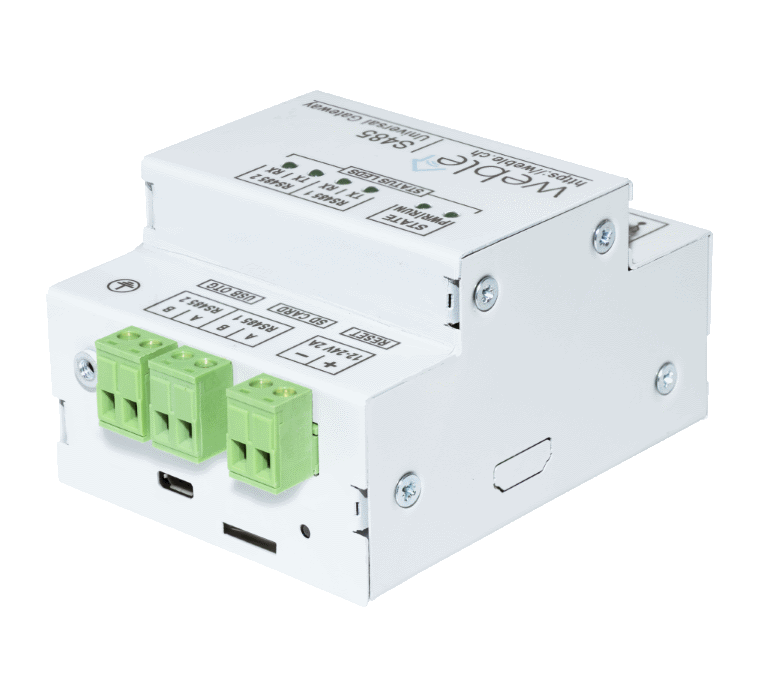
The standard field-bus gateway with two RS485 ports. A versatile and cost-effective choice for most building automation projects.
| Spec | Value |
|---|---|
| CPU | 4× Cortex-A7, 1.2 GHz |
| RAM | 1 GB |
| Storage | microSD card (included, Armbian pre-installed) |
| Ethernet | 1× (100 Mbps) |
| RS485 | 2× (Modbus / BACnet) |
| USB | 3× USB + 1× USB-OTG |
| Power | 12–24 V DC |
| Housing | Steel case, DIN-rail (35 mm) |
| Weight | 0.25 kg |
| RTC | Yes, battery-backed |
| OS | Armbian |
¶ S485 KNX
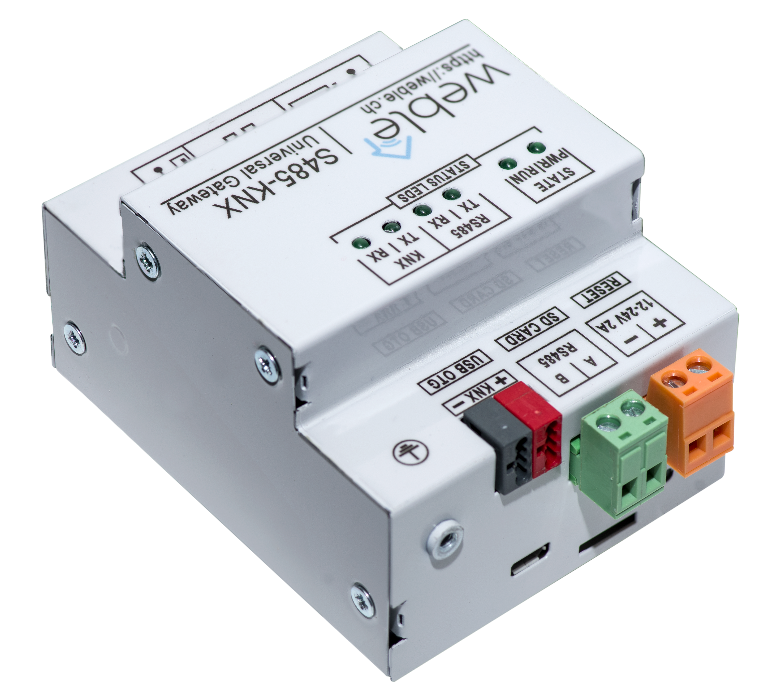
Same platform as the S485 but with one RS485 replaced by a native KNX twisted pair port. Connects directly to the KNX bus without an external KNX/IP router — the simplest setup for KNX integration.
| Spec | Value |
|---|---|
| CPU | 4× Cortex-A7, 1.2 GHz |
| RAM | 1 GB |
| Storage | microSD card (included, Armbian pre-installed) |
| Ethernet | 1× (100 Mbps) |
| RS485 | 1× (Modbus / BACnet) |
| KNX | 1× twisted pair (direct bus connection) |
| USB | 3× USB + 1× USB-OTG |
| Power | 12–24 V DC |
| Housing | Steel case, DIN-rail (35 mm) |
| Weight | 0.25 kg |
| RTC | Yes, battery-backed |
| OS | Armbian |
See the KNX driver documentation for connection modes and ETS remote access.
¶ S103
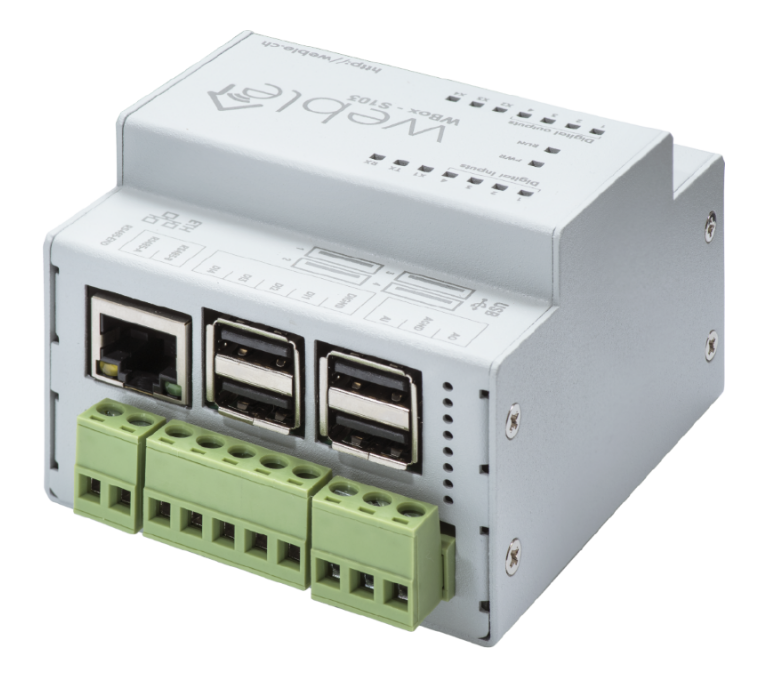
An I/O controller with built-in digital inputs/outputs, analog I/O, and a 1-Wire bus — ideal when the gateway needs to interact directly with sensors and actuators without an external PLC. Also includes an RS485 port for field-bus connectivity.
| Spec | Value |
|---|---|
| CPU | 4× 1.2 GHz |
| RAM | 1 GB |
| Storage | microSD card (included) |
| Ethernet | 1× (100 Mbps) |
| RS485 | 1× (Modbus / BACnet) |
| Digital inputs | 4× (5–24 V DC) |
| Digital outputs | 4× transistor (max 750 mA @ 50 V DC) |
| Analog input | 1× (0–10 V / 4–20 mA) |
| Analog output | 1× (0–10 V) |
| 1-Wire | 1× bus with galvanic isolation |
| USB | 4× |
| Wi-Fi | Access point / client |
| Power | 24 V DC |
| Housing | Anodized aluminum, DIN-rail (35 mm) |
| Weight | 0.3 kg |
| RTC | Yes, battery-backed (7-day retention) |
The I/O is accessed through the IO driver. The 1-Wire bus supports temperature sensors (DS18B20 and compatible).
¶ Common features
Regardless of the model, every Weble IoT Universal Gateway provides:
- The same catalogue of communication drivers on every model: Modbus, BACnet, KNX, OPC UA, MQTT, HTTP, M-Bus and more than 60 drivers in total. The IO driver exposes the physical inputs and outputs that the model has.
- The routing engine, logic module, and views.
- The Peers API and REST API.
- Local logging and history: see Logging and history.
- Tinc VPN client for the Weble Cloud mesh network.
- PM2-based process supervision with automatic restarts and crash logs.
- Firmware and supervision upgrades over HTTP.
¶ Choosing a model
| Need | Recommended model |
|---|---|
| Cellular / remote site without wired internet | E413-LTE |
| Remote M-Bus metering over a cellular uplink | E413-MBUS-LTE |
| Dual-network (building LAN + field-bus network) | G110 |
| Standard Modbus / BACnet / MQTT gateway | S485 |
| Direct KNX bus connection without IP router | S485 KNX |
| Direct sensor/actuator I/O (no external PLC) | S103 |
| Maximum processing power or large-scale installations | E413-LTE (4 GB RAM, Cortex-A72) |
All models are available at weble.ch. Contact Weble for pricing and availability.
¶ Identifying the model at runtime
From the gateway web UI: Administration → System, box System informations, line Device.
The Device line shows the hardware platform identifier of the device, which can differ from the commercial reference. For example, an S103 shows Unipi Neuron S103, or a variant such as Unipi Neuron S103 RPI4.
From the API:
peer('supervision').require('system', function(err, system){
    console.log('hardware:', system.baseDevice)
})